Our house (Carlos's parents house) in Cuenca overlooks a park. The park isn't very big, about the size of three standard lots. Right now, there are about 40 skinny teenage boys hanging out there. I think there is a fight. Some beautiful yellow flowering trees block my view, but I saw about three punches thrown. And one kick. Then the smaller guy running away. I've heard lots of cheers and groans (the boys are loud and windows thin). There are about half a dozen girls there too, but they are watching from across the street.
I asked Carlos's parents about the boys in the park, they were downstairs and hadn't heard them. So we tried to view it from the living room, still too many trees. We couldn't even see if we stood on the couch. So we went to the balcony of their room. Papi couldn't care less, but Mami seemed to want to watch the fight. Still, too many trees. So back to cooking for Carnival.
Now they are dissipating. It's over.
Friday, February 20, 2009

Thursday, February 19, 2009
Cooking for Carnival
Apparently we will spend all of Saturday making breads, but that's not what I want to write about now. There is the most amazing savory smell coming from the kitchen right now. I went downstairs to investigate. It turns out that my future mother-in-law is rendering lard (I think that's the right term, I may need to look it up). At lunch I saw some cubes of flesh on the stove, which looked like fish actually, so I didn't ask any questions. Now, about an hour and a half later, I realize that that was not fish, it was chunks of pork fat. And now they are melting into pure lard.
And it smells great.
And it smells great.
Tuesday, February 17, 2009
Baños
To recover from our days in the field, Carlos and I decided to go to Baños on Sunday. There are actually two Baños in Ecuador (or maybe more, but I only know of two), one is just a small town on the outskirts of Cuenca (which is where we went), the other is near Riobamba, sort of the gateway to the jungle. Both have natural hot springs, aka, thermal baths, thus the name "Baños".
So, in the Baños near Cuenca there are a few baths to visit, but when had gotten free passes to Pierdra de Agua, a spa so new that they haven't even finished the construction. But we didn't know that until we got there. The passes were to expire in two weeks, so we wanted to use them before it was too late.
The spa was beautiful, mainly constructed with a reddish volcanic stone. The decor was very modern, but chic as well. Not typical Ecuadorian. We were greeted when we arrived and given a tour. I was surprised by all the attention paid to us, which, again, is not very typical here in Ecuador, but I think it was because we were the only people there. I mean there were a few others walking around, but we were the only ones actually using the facilities. We were able to use the Turkish baths and the pools, because those were the only things that were open. Actually, the Turkish baths were not quite working when we arrived, but they fixed them for us.
They told us that in about 3-5 months the rest will be completed, underground pools, massages, steam boxes, outdoor showers, etc. I think that we'll be visiting again when they have completed the place.
So, in the Baños near Cuenca there are a few baths to visit, but when had gotten free passes to Pierdra de Agua, a spa so new that they haven't even finished the construction. But we didn't know that until we got there. The passes were to expire in two weeks, so we wanted to use them before it was too late.
The spa was beautiful, mainly constructed with a reddish volcanic stone. The decor was very modern, but chic as well. Not typical Ecuadorian. We were greeted when we arrived and given a tour. I was surprised by all the attention paid to us, which, again, is not very typical here in Ecuador, but I think it was because we were the only people there. I mean there were a few others walking around, but we were the only ones actually using the facilities. We were able to use the Turkish baths and the pools, because those were the only things that were open. Actually, the Turkish baths were not quite working when we arrived, but they fixed them for us.
They told us that in about 3-5 months the rest will be completed, underground pools, massages, steam boxes, outdoor showers, etc. I think that we'll be visiting again when they have completed the place.
Sunday, February 15, 2009
Welcome to the Jungle
Yesterday Carlos and I returned from four days of camping. It was for work. Carlos has a job assessing a protected area near Cuenca and advising the municipality on what to do with it. About 20 to 30 years ago it was used as a scientific station but has been sort of abandoned, which is good for the forest because we have been able to observe natural regeneration. Three other friends were there with us, all biologists. They mainly counted birds and trapped animals.
Anyway, there is a small building there where we were able to stay, rather than in tents. But the building didn't have too much to offer. There is water, but no electricity. The water is piped in from a waterfall nearby (I boiled it to drink, the guys did not, Carlos thought I was being paranoid, but I responded by telling him that I was the one with the degree in "don't drink the water"). They have a parallel line that used to run a hydroelectric generator, but it's not in use anymore. There is an old stove in there, but we were not provided with gas, so we cooked over a camping stove. I know this because my duties on this trip was "drafter" (there aren't any records of the building we stayed in, so I made some), "engineer" (analysis of potable and waste water systems), and "chef."
 But besides that work, I went hiking with the boys as well. The longest day was 8 hours, my shortest was 3 hours (I think Carlos' shortest was about 6 hours). And I should state that we weren't actually in the jungle. We were in an Andean forest. But it was like the jungle, just a bit cooler, higher, and without snakes. There was knee deep mud (well, upper calf deep, coming just to the top of our galoshes, which, by the way, are terrible to hike in since the soles are thin and slippery, but do a great job of keeping feet dry) and we were wielding machetes.
Well, only one machete. And I got to wield it a few times. It's really quite hard to hack your way through the forest. I was not very good at it. There were trails, but they were a bit overgrown. Can you see the trail?
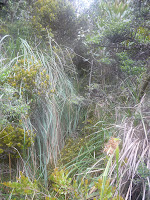
Yeah, I couldn't either, but it's there. Even though it was tough, I had a great time.
Anyway, there is a small building there where we were able to stay, rather than in tents. But the building didn't have too much to offer. There is water, but no electricity. The water is piped in from a waterfall nearby (I boiled it to drink, the guys did not, Carlos thought I was being paranoid, but I responded by telling him that I was the one with the degree in "don't drink the water"). They have a parallel line that used to run a hydroelectric generator, but it's not in use anymore. There is an old stove in there, but we were not provided with gas, so we cooked over a camping stove. I know this because my duties on this trip was "drafter" (there aren't any records of the building we stayed in, so I made some), "engineer" (analysis of potable and waste water systems), and "chef."
 But besides that work, I went hiking with the boys as well. The longest day was 8 hours, my shortest was 3 hours (I think Carlos' shortest was about 6 hours). And I should state that we weren't actually in the jungle. We were in an Andean forest. But it was like the jungle, just a bit cooler, higher, and without snakes. There was knee deep mud (well, upper calf deep, coming just to the top of our galoshes, which, by the way, are terrible to hike in since the soles are thin and slippery, but do a great job of keeping feet dry) and we were wielding machetes.
Well, only one machete. And I got to wield it a few times. It's really quite hard to hack your way through the forest. I was not very good at it. There were trails, but they were a bit overgrown. Can you see the trail?

Yeah, I couldn't either, but it's there. Even though it was tough, I had a great time.
Wednesday, February 04, 2009
Consulting
Since I still don't have my visa, I have been assisting Carlos in his job (n.b. - this is not work, I am not getting paid, thus am not working illegally). He and some friends from university have restarted their company, Biota, and Carlos already has three or four contracts.
He's a biologist and does Environmental Impact Assessments. The field work makes it one of the best jobs ever. We go on hikes. That's the job. I mean, on those hikes he counts trees and flowers while I take photos when he asks (and also when he doesn't). Or we go down by the river and collect water samples. On Monday we went to Mazan, a protected area that the municipality needs data for so they can decide what to do with it.
Unfortunately, all the hiking has shown me that I am still quite out of shape. I mean, we typically hike for three or four hours, with only about a 200m change in grade, but through mud and squishy soils. Though going uphill is tough, for me the hardest part is when we go off trail and have to hold on to the trees for support. It's fun, but I'm still afraid to touch things. But when I don't touch things, I fall. Even when I am careful about what I touch I still end up with splinters and cuts on my hands.
My package arrived safely yesterday. The Economist is doing fine.
He's a biologist and does Environmental Impact Assessments. The field work makes it one of the best jobs ever. We go on hikes. That's the job. I mean, on those hikes he counts trees and flowers while I take photos when he asks (and also when he doesn't). Or we go down by the river and collect water samples. On Monday we went to Mazan, a protected area that the municipality needs data for so they can decide what to do with it.
Unfortunately, all the hiking has shown me that I am still quite out of shape. I mean, we typically hike for three or four hours, with only about a 200m change in grade, but through mud and squishy soils. Though going uphill is tough, for me the hardest part is when we go off trail and have to hold on to the trees for support. It's fun, but I'm still afraid to touch things. But when I don't touch things, I fall. Even when I am careful about what I touch I still end up with splinters and cuts on my hands.
My package arrived safely yesterday. The Economist is doing fine.
Tuesday, February 03, 2009
The Economist: The $100 issue
When my parents visited in December, they brought me lots of wonderful gifts from home. Basically, everyday items that I could not find here, like pine nuts and vanilla extract. And The Economist - my favorite magazine. It is not published in Ecuador because the guy who owns the rights has chosen not to publish it, probably because he couldn't make money off of it. I'm sure that I would be one of maybe 13 readers in this country of 13 million.
Unfortunately, the special double winter issue, which is the best of the best, was not available when my parents were coming here, so they shipped it to me when they returned to the states, along with a book, a sweater, some contact lenses, Cheez-Its. All simple stuff. The FedEx invoice stated the value of all items to be $25 (even though they are probably worth a little more). I don't know how much the shipping itself cost, but lets assume another $30, or more like $40 when you include the labor done my my parents to acquire and pack all the items. That's $65 already...
The package was shipped three weeks ago. It was supposed to arrive two weeks ago. After repeated calling, we finally found out where the package was. As of yesterday it was in Cuenca, but to get it into my possession I need to pay another $35! This is how it breaks down...customs is about $20. I mean, I have to pay $20 for customs to go through my box, try on my sweater, and probably eat the Cheez-Its. Apparently the government does not pay for this service, but the people using it do. Of that $20, $15 is for "management," $2 is for "storage" and $3 for "other." Then that $20 is taxed. So I get to pay about $23 for the privilege of customs keeping my stuff in a warehouse for two weeks.
Then there is the other bill, $12 in taxes. I need to pay $12 in import taxes on items that are worth $25. That's about 50%! And then, of course, I have to pay taxes on the taxes (well, I guess it's taxes on the tariff, but that's really the same).
So, in total, one issue of The Economist has now cost $100.
I hope that it's good :)
Unfortunately, the special double winter issue, which is the best of the best, was not available when my parents were coming here, so they shipped it to me when they returned to the states, along with a book, a sweater, some contact lenses, Cheez-Its. All simple stuff. The FedEx invoice stated the value of all items to be $25 (even though they are probably worth a little more). I don't know how much the shipping itself cost, but lets assume another $30, or more like $40 when you include the labor done my my parents to acquire and pack all the items. That's $65 already...
The package was shipped three weeks ago. It was supposed to arrive two weeks ago. After repeated calling, we finally found out where the package was. As of yesterday it was in Cuenca, but to get it into my possession I need to pay another $35! This is how it breaks down...customs is about $20. I mean, I have to pay $20 for customs to go through my box, try on my sweater, and probably eat the Cheez-Its. Apparently the government does not pay for this service, but the people using it do. Of that $20, $15 is for "management," $2 is for "storage" and $3 for "other." Then that $20 is taxed. So I get to pay about $23 for the privilege of customs keeping my stuff in a warehouse for two weeks.
Then there is the other bill, $12 in taxes. I need to pay $12 in import taxes on items that are worth $25. That's about 50%! And then, of course, I have to pay taxes on the taxes (well, I guess it's taxes on the tariff, but that's really the same).
So, in total, one issue of The Economist has now cost $100.
I hope that it's good :)
Wednesday, January 21, 2009
I Have a New President...
...and am really excited. It actually was cool that the inauguration speech was on TV here, but it was being simultaneously translated, so I could barely hear the English under the Spanish, and while I was trying to understand the Spanish I missed the English.
Anyway, it's nice to hear that my fellow Americans have hope, since I'm quite pessimistic about Ecuador. The government is trying to gets its fingers into everything. Prices are going up, they're grabbing land from the rich to give to the poor, private pensions are disappearing. Oh, and the box that my Dad sent full off books, contact lenses, and a sweater, will take between 15 to 30 days to clear customs! Maybe I'll feel better once I finally get my visa.
Anyway, it's nice to hear that my fellow Americans have hope, since I'm quite pessimistic about Ecuador. The government is trying to gets its fingers into everything. Prices are going up, they're grabbing land from the rich to give to the poor, private pensions are disappearing. Oh, and the box that my Dad sent full off books, contact lenses, and a sweater, will take between 15 to 30 days to clear customs! Maybe I'll feel better once I finally get my visa.
Friday, January 16, 2009
Donations to the Government of Ecuador
Everyday we get a new call from the lawyer, saying that more documentation for my visa is needed. They now need my original diplomas. The notarized and apostilled copies apparently don't count. Those liars! Why did they tell me that they were acceptable in the first place?
Now the lawyer tells us that we have to pay a fine, about $200, because we didn't start the process soon enough. We should have started it a month before the tourist visa expired. We met with the lawyer (about six weeks before the visa expired) she mentioned nothing of the sort. Then she told us that the law has changed. Which isn't true. Arrrrgh.
Now the lawyer tells us that we have to pay a fine, about $200, because we didn't start the process soon enough. We should have started it a month before the tourist visa expired. We met with the lawyer (about six weeks before the visa expired) she mentioned nothing of the sort. Then she told us that the law has changed. Which isn't true. Arrrrgh.
Friday, January 09, 2009
Alejandro Is Right
He's right. It's not that I haven't been inspired to write, I've just been lazy. I wish that I could have said "busy" instead of "lazy".
So, what shall I complain about first. I think our attempts to get me a work visa is at the top of the list. My tourist visa expired on December 30th. So, for the month prior, Carlos and I were researching and collecting what documents we needed (yep, I'm working for him now) and even my parents were getting diplomas apostilled for me prior to their visit. We called our lawyer here about once a week and she assured us that we had all the documents that we needed. Well, she was wrong. Really wrong.
For the past three weeks, yes even during the holidays when practically everything is closed, we have been getting calls from the lawyer everyday, saying that we need one more form. Actually, we are now working with one of her partners since he has deemed her incompetent on this issue.
Carlos did most of the running around, since lots of the documents needed applied to him rather than me. But I did join him for one round of documentation. It was terrible. Apparently, for my work visa, I need some insurance that is like social security. But I need to pay for the month of December (yes, even though I am not working that month and am still a tourist at that point). First I need an ID number. Carlos got that for me last week (I don't know how, but he did). But we had to pay the insurance in person. So we went to the institute to pay. I waited in line for over two hours before I even got close to the cashier. During this time, Carlos was running around, making sure there was money in the parking meter, getting the receipt that we needed to pay, getting money (we had not brought enough since we didn't know that we had to pay for him and me at the same time), and asking basic questions that no one could answer.
So about this line, it went out the door. One women told us that there used to be a take a number system. But apparently they changed that. Someone thought that having a security guard act as a line monitor was more efficient. Oh, and of the four windows available, only two women were working, well for at least a little while. After half an hour or so, one went to lunch. That means one cashier for a line of 200 people. Then, just as I was approaching the window, the women came back from lunch. Her counterpart basically stopped in the middle of the transaction of the man ahead of me and just left. So he finished his transaction with my cashier. Then we finally paid.
Apparently many people wait in line and pay cash, because wasting two hours in line each month is easier than setting up automatic withdrawal from the bank. We are now trying to set up the automatic withdrawal. We got the form, but the bank said that first the insurance office needs to sign it. The insurance office then said that the bank needs to sign it first. So back to the bank and the women there said we need to sign it, then make four copies and come back the next day.
So, to generalize my complaint, the problem with this country is that there is no standard procedure for anything, and when there is, no one actually knows the process or if they do, no one follows it...
So, what shall I complain about first. I think our attempts to get me a work visa is at the top of the list. My tourist visa expired on December 30th. So, for the month prior, Carlos and I were researching and collecting what documents we needed (yep, I'm working for him now) and even my parents were getting diplomas apostilled for me prior to their visit. We called our lawyer here about once a week and she assured us that we had all the documents that we needed. Well, she was wrong. Really wrong.
For the past three weeks, yes even during the holidays when practically everything is closed, we have been getting calls from the lawyer everyday, saying that we need one more form. Actually, we are now working with one of her partners since he has deemed her incompetent on this issue.
Carlos did most of the running around, since lots of the documents needed applied to him rather than me. But I did join him for one round of documentation. It was terrible. Apparently, for my work visa, I need some insurance that is like social security. But I need to pay for the month of December (yes, even though I am not working that month and am still a tourist at that point). First I need an ID number. Carlos got that for me last week (I don't know how, but he did). But we had to pay the insurance in person. So we went to the institute to pay. I waited in line for over two hours before I even got close to the cashier. During this time, Carlos was running around, making sure there was money in the parking meter, getting the receipt that we needed to pay, getting money (we had not brought enough since we didn't know that we had to pay for him and me at the same time), and asking basic questions that no one could answer.
So about this line, it went out the door. One women told us that there used to be a take a number system. But apparently they changed that. Someone thought that having a security guard act as a line monitor was more efficient. Oh, and of the four windows available, only two women were working, well for at least a little while. After half an hour or so, one went to lunch. That means one cashier for a line of 200 people. Then, just as I was approaching the window, the women came back from lunch. Her counterpart basically stopped in the middle of the transaction of the man ahead of me and just left. So he finished his transaction with my cashier. Then we finally paid.
Apparently many people wait in line and pay cash, because wasting two hours in line each month is easier than setting up automatic withdrawal from the bank. We are now trying to set up the automatic withdrawal. We got the form, but the bank said that first the insurance office needs to sign it. The insurance office then said that the bank needs to sign it first. So back to the bank and the women there said we need to sign it, then make four copies and come back the next day.
So, to generalize my complaint, the problem with this country is that there is no standard procedure for anything, and when there is, no one actually knows the process or if they do, no one follows it...
Subscribe to:
Posts (Atom)


